Provider review
A licensed provider reads your health and skin history, decides if a hydroquinone cream is right for you and chooses the course.
Compounded medicine, by prescription
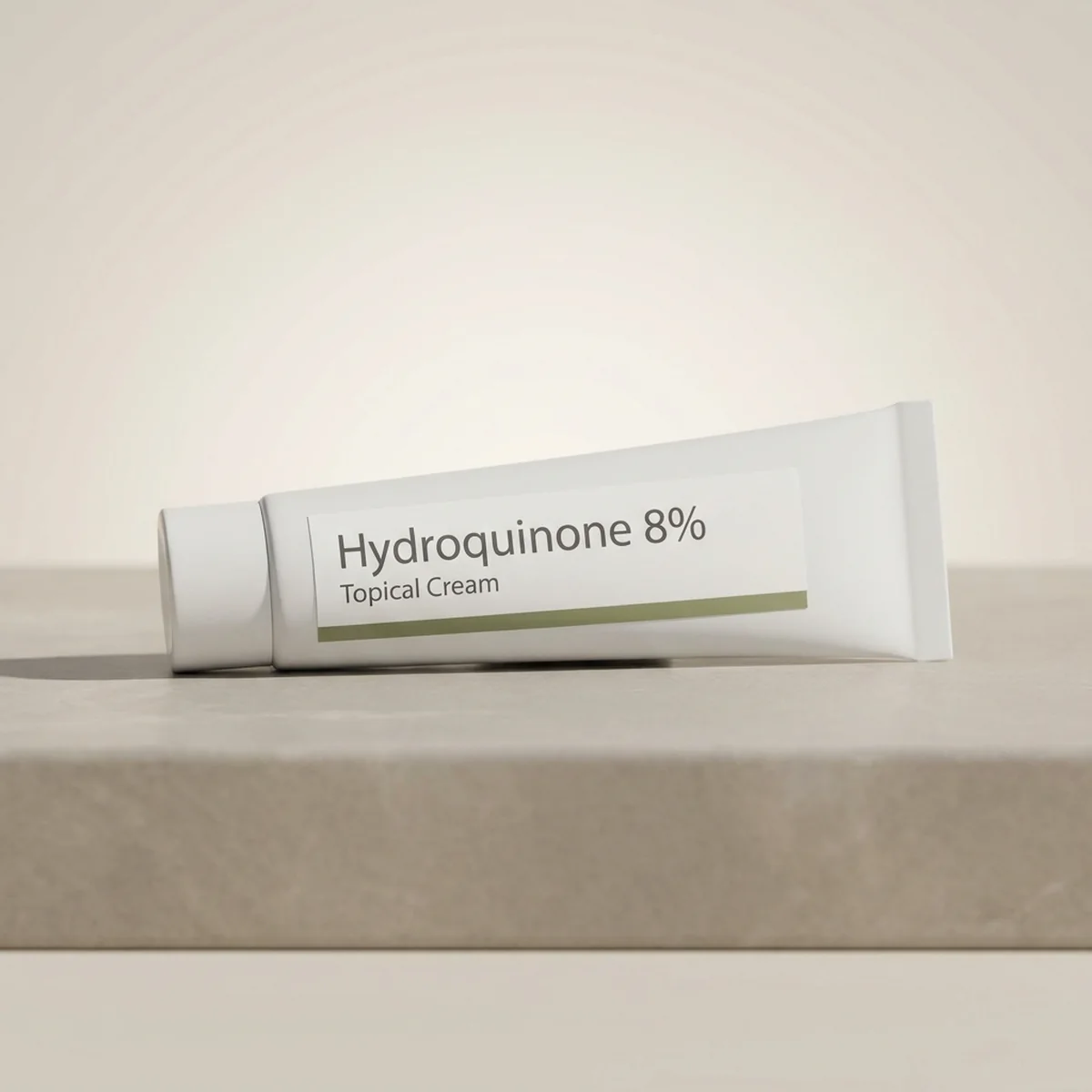
A compounded hydroquinone 8% cream with tretinoin, niacinamide and vitamin C, after a licensed provider's review. Not FDA approved. A licensed 503A compounding pharmacy prepares your order and ships it free.
From $107/mo with the 12-month plan and auto-refill
How would you like to pay?
Choose your plan
Prescription treatment requires an online medical evaluation. A provider decides whether treatment is appropriate; approval is not guaranteed.
Product details
Your plan
A licensed provider reads your health and skin history, decides if a hydroquinone cream is right for you and chooses the course.
A compounded hydroquinone 8% blend with tretinoin, niacinamide and vitamin C, prepared by a licensed compounding pharmacy after approval.
Delivered to your door at no added cost.
Pay once, or turn on auto-refill and take 10% off. Change or cancel refills anytime.
A printable decision pack and a plain checklist for reading a study.
Help with your order and delivery when you need it.
How it works
Pick 1, 3, 6 or 12 months. Auto-refill takes 10% off each plan.
Answer a private online questionnaire. A licensed provider reviews it and chooses the course.
If prescribed, the pharmacy prepares your order and ships it to you free.
Why people choose it
Each card links to the original study, with a tag for the kind of evidence behind it.
The Tri-Luma label states the cream is indicated for the short-term treatment of moderate to severe melasma of the face, in the presence of measures for sun avoidance, including the use of sunscreens.
Read the study Controlled human trialIn the combined analysis of two 8-week trials, 26.1% of patients treated with the triple combination (tretinoin 0.05%, hydroquinone 4.0%, fluocinolone acetonide 0.01%) had complete clearing at the end of week 8, compared with 4.6% in the other treatment groups (P<.0001).
Read the study Controlled human trialIn a randomized controlled trial in Asian patients, 77/120 patients (64.2%) on the triple combination had a global severity score of none or mild at week 8 versus 48/122 patients (39.4%) on hydroquinone (P < 0.001), and more patients had related adverse events on the triple combination (63/129, 48.8%) than on hydroquinone (18/131, 13.7%).
Read the study Small human studyA systematic review of published case studies of hydroquinone-associated ochronosis concluded that hydroquinone in concentrations above 4% and in treatment courses longer than 3 months may be associated with new-onset ochronosis.
Read the studyThe honest version
The trials we found studied hydroquinone at 4%, and we did not find a trial of 8% or of this four-ingredient blend. Here is what the sources say, including limits and strength-related warnings.
See every study we trackA systematic review of published case studies of hydroquinone-associated ochronosis concluded that hydroquinone in concentrations above 4% and in treatment courses longer than 3 months may be associated with new-onset ochronosis.
SourceA DailyMed listing from one labeler names a hydroquinone 8% / tretinoin 0.025% emulsion in a 30gm package, shows the marketing status unapproved drug other, and states that the drug has not been found by FDA to be safe and effective and that the labeling has not been approved by FDA.
SourceFDA states that currently Tri-Luma is the only FDA-approved drug containing hydroquinone, a prescription product approved for the short-term treatment of dark spots associated with moderate-to-severe melasma of the face.
SourceFDA states that compounded drugs are not FDA-approved, which means FDA does not verify the safety, effectiveness or quality of compounded drugs before they are marketed.
SourceA Cochrane review of melasma treatments concluded that the quality of studies evaluating melasma treatments was generally poor and available treatments inadequate, and called for high-quality randomised trials with long-term outcomes.
SourceThe Tri-Luma label (fluocinolone acetonide 0.01%, hydroquinone 4%, tretinoin 0.05%) states that remission periods appeared to shorten between progressive courses of treatment and that few subjects (approximately 1 to 2%) maintained complete clearing of melasma.
SourceThe Tri-Luma label states that its safety and efficacy in patients of Fitzpatrick Skin Types V and VI have not been studied and that excessive bleaching in patients with darker skin cannot be excluded.
SourceFAQ
The things people ask most before starting Hydroquinone 8%.
A compounded hydroquinone 8% cream blended with tretinoin, niacinamide and vitamin C, after a licensed provider's review. Your provider chooses the course. A licensed 503A compounding pharmacy prepares your order and ships it free.
Hydroquinone 8% paid once: $149 for 1 month, $402 for 3 months, $760 for 6 months or $1,430 for 12 months. With auto-refill each is 10% off: $134, $361, $684 and $1,287 ($107.25 a month on the 12-month plan). Shipping is free, and the exact total is shown before you pay.
Yes. You complete an online health intake and a licensed provider decides whether a hydroquinone cream is right for you and chooses the course. Choosing a plan does not guarantee a prescription.
FDA states that currently Tri-Luma is the only FDA-approved drug containing hydroquinone, a prescription product approved for the short-term treatment of dark spots associated with moderate-to-severe melasma of the face. It contains fluocinolone acetonide 0.01%, hydroquinone 4% and tretinoin 0.05%. FDA also states that since enactment of the CARES Act, over-the-counter skin lightening products containing hydroquinone are deemed to be new drugs and are misbranded. The cream sold here is compounded, and FDA states that compounded drugs are not FDA-approved, which means FDA does not verify the safety, effectiveness or quality of compounded drugs before they are marketed.
We did not find a trial of hydroquinone 8% or of this blend in the sources we reviewed. The trials linked on this site studied 4% hydroquinone, mostly in a triple combination with fluocinolone acetonide and tretinoin, or compared 4% hydroquinone cream with 4% niacinamide cream or 5% ascorbic acid cream. A systematic review of published case studies of hydroquinone-associated ochronosis concluded that hydroquinone in concentrations above 4% and in treatment courses longer than 3 months may be associated with new-onset ochronosis, and a dermatologist's review written in response to the FDA's proposed ban reported 22 cases in the United States in more than 50 years, in a literature review involving over 10,000 exposures under careful clinical supervision, without breaking them down by concentration.
A prescription hydroquinone 4% cream label listed on DailyMed as an unapproved drug states that topical hydroquinone produces a reversible depigmentation of the skin by inhibition of the enzymatic oxidation of tyrosine to 3,4-dihydroxyphenylalanine (dopa), and a review abstract says hydroquinone can competitively inhibit the enzyme tyrosinase. The Tri-Luma label states that the mechanism of action of its active ingredients in the treatment of melasma is unknown.
In the combined analysis of two 8-week trials, 26.1% of patients on the 4% triple combination had complete clearing at week 8 versus 4.6% in the other treatment groups, and the label reports treatment success of 38% in trial 1 and 13% in trial 2 for the triple combination. In a randomized trial in Asian patients, 64.2% on the triple combination had a global severity score of none or mild at week 8 versus 39.4% on hydroquinone cream. A Cochrane review found triple-combination cream significantly more effective at lightening melasma than hydroquinone alone (RR 1.58, 95% CI 1.26 to 1.97) and concluded that the quality of studies was generally poor. Split-face trials found no statistical differences in colorimetric measures between 4% hydroquinone and 4% niacinamide, or between 4% hydroquinone and 5% ascorbic acid.
The Tri-Luma label (hydroquinone 4%) reports that in its controlled trials 102 (63%) of 161 subjects had at least one treatment-related adverse event, most frequently erythema 41%, desquamation 38%, burning 18%, dryness 14% and pruritus 11%, mostly mild to moderate. It warns that the hydroquinone may produce exogenous ochronosis, a gradual blue-black darkening of the skin, and that its occurrence should prompt discontinuation. These figures are for that product, not for hydroquinone 8%.
The Tri-Luma label says to use a sunscreen of SPF 30 and protective clothing during the day and to avoid sunlight, and states that sunscreen use is an essential aspect of melasma therapy because even minimal sunlight sustains melanocytic activity. It also states that its safety and efficacy in patients of Fitzpatrick Skin Types V and VI have not been studied and that excessive bleaching in patients with darker skin cannot be excluded.
The Tri-Luma label states the cream is indicated for short-term treatment, is not indicated for maintenance treatment, and that melasma usually recurs upon discontinuation; it also states that remission periods appeared to shorten between progressive courses and that few subjects (approximately 1 to 2%) maintained complete clearing. A prescription hydroquinone 4% cream label listed as an unapproved drug says to discontinue if no improvement is seen after 2 months. Your provider chooses the course for the cream sold here.
The Tri-Luma label states that there are no adequate and well-controlled studies in pregnant women and that the cream should be used during pregnancy only if the potential benefit justifies the potential risk to the fetus, and that it contains the teratogen tretinoin, which may cause embryo-fetal death, altered fetal growth, congenital malformations, and potential neurologic deficits. It also says caution should be exercised when administered to a nursing woman. The Tri-Luma patient leaflet says to tell your doctor if you are pregnant or plan to become pregnant, and to tell your doctor right away if you become pregnant while using the cream.
FDA states that compounded human drug products that meet its stated conditions are exempt from the FD&C Act sections on FDA approval prior to marketing, current good manufacturing practice (CGMP) requirements, and labeling with adequate directions for use, and that one of these conditions is that the drugs must be compounded based on the receipt of valid patient-specific prescriptions. FDA also states that compounded drugs should only be used in patients whose medical needs cannot be met by an FDA-approved drug.
The Tri-Luma patient leaflet says to stop using the cream and tell a doctor if a blue-black darkening of the skin develops, and to call a doctor to get medical help right away for symptoms including swelling of the face, eyes, lips, tongue, or throat, trouble breathing, severe itching, skin rash or hives, or change in skin color.
No. You can pay once for 1, 3, 6 or 12 months, or turn on auto-refill and take 10% off. You can change or cancel refills anytime.